Home

TestPage_SJ

1. Test item 1 – Heading (H2)

Example UConn Today Post: U.S. National Science Foundation Announces Transformational Award to Connecticut’s Quantum Tech Sector  
jonathan the husky mascot

The U.S. National Science Foundation (NSF) announced today that Connecticut is one of twelve regions selected to receive an NSF Regional Innovation Engines (NSF Engines) award, joining a portfolio of regional technology clusters that are accelerating the development of critical technologies and building a durable U.S. technology advantage.

The NSF Quantum Technologies Engine in Connecticut, led by the University of Connecticut in partnership with Yale University, Southern Connecticut State University, Connecticut State Community College, ConnCORP, Connecticut Innovations, and the State of Connecticut, aims to advance American quantum innovation and secure the domestic quantum supply chain by accelerating the commercialization of quantum technologies for national defense, biotechnology, and financial services. Through innovation, applied research leading to new technologies, support for inventors and entrepreneurs, and workforce development, the NSF Quantum Technologies Engine will advance quantum sensing, secured communications, computing, and materials through shared testbed, deep-tech incubator and translation pathways.

“NSF Engines investments in critical technologies and future industries will transform America’s innovation infrastructure for decades to come,” says Brian Stone, performing the duties of the NSF director. “The NSF Quantum Technologies Engine will advance the Nation’s quantum innovation by accelerating the commercialization of quantum technologies for national defense, biotechnology and financial services.”

The NSF Quantum Technologies Engine in Connecticut (the QuantumCT Engine) team will initially receive a two-year, $15 million award. The funds will support the Engine’s technology translation, workforce development, and incubator operations. The funds will also facilitate industry and community engagement to deliver broad societal benefits. By demonstrating sufficient progress, the QuantumCT Engine has the potential to receive $160 million from NSF over the next decade.

The QuantumCT Engine will leverage world-leading research and innovation expertise from UConn and Yale to pursue translational research to benefit industry, generate technology ventures, and train the region’s workforce to enter a high-growth field. It will also deliver technology acceleration and startup support services to drive public-private partnerships and create a quantum ecosystem that generates economic growth.

Quantum technology industries are expected to grow to $200 billion by 2040, with the potential to reshape sectors important to Connecticut and the country, including aerospace, defense, drug development, manufacturing, and finance and insurance.

Kate’s Page

News

The Mission of the Institute of Materials Science (IMS) is to promote education, research, and outreach concerning materials to students, faculty members, and especially to industries in the State of Connecticut. IMS was established by the CT Legislature in 1965 to carry out this Mission.

jonathan the husky mascot

Diversity, equity, and inclusion are among the core values of the University of Connecticut and the Institute of Materials Science. We recognize that diversity in outlook and approach, equity on all levels, and total inclusion all contribute to a vibrant intellectual environment, promote deep understanding of our society’s shared challenges, and cultivate perspectives needed to solve problems of the future. Our team is committed to fostering a diverse and inclusive working environment where we value and develop employees of all backgrounds and experiences. We firmly believe collaboration among team members with varied experiences, perspectives and viewpoints generates more incisive and deeper insight that better serves our people, partners, customers, and communities.

New Page

News for Today

Elizabeth “Lizzie” Searing greets Teangeley Centeno ’28 (CLAS) and Juve Perez ’28 (ENG) as they walk up to the window of her stainless-steel food truck not by asking for their food order but by asking how their spring break in Puerto Rico went.

Jonathan UConn Husky Mascot
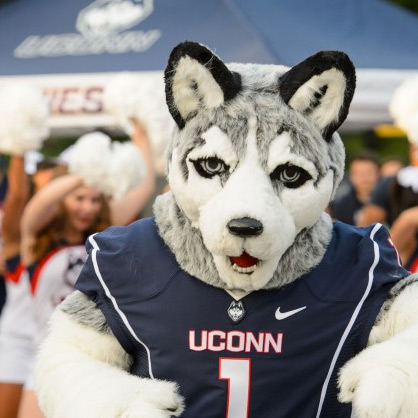
Jonathan the Husky dances with cheerleaders during the UConn Football pep rally held on Fairfield Way on Aug. 28, 2014. (Peter Morenus/UConn Photo)

“It was great! But we missed your food,” Teangeley says.

The couple has been going to Lizzie’s Curbside every morning since their first visit their first year at UConn when they ordered The Mighty Mouth — a breakfast sandwich that layers bacon, ham, and sausage with egg and cheese.

“We discovered it freshman year, and we just started binge eating it, and then we just couldn’t stop,” Centeno says.

She and Perez have gotten to know proprietors Lizzie and her husband, Joie, well. Someday they hope to have Lizzie cater their wedding.

On this frosty day in mid-March following two massive snowstorms, the Searings have just returned to campus after their annual winter break in Hallandale Beach, Florida. Lizzie leans out the front window of her truck, taking orders in a black ­button-up chef’s shirt embroidered with “Lizzie.” Her hair in a messy ponytail, she moves around the truck quickly, talking to customers as she works. Her 6-year-old golden retriever, Melo, sits across the road on a grassy hill, luring customers for head scratches.

After some three decades parked on Whitney Road, construction forced temporary relocation last year to Fairfield Way. From her new spot near Hawley ­Armory, Lizzie greets customers, many by name.

“UConn is my home. It’s my family,” she says. “I know a lot of people, and I don’t know what I would do if I wasn’t here.”

This February marked 35 years of serving Husky Nation. Just 27 years old and a newlywed when she and Joie moved to the area, Lizzie began contemplating a suggestion from a former boss: Open a hot dog cart on the UConn campus — it will get a lot of business. That’s how she found herself in Storrs on February 1, 1991, shivering and serving hot dogs on the sidewalk by Mirror Lake. “I had my hot dog wagon, which had a steam table and a coffee urn, and that was it. I stood on the ground out in the elements, out in the cold,” she recalls.

From that $100 day, her business grew. “People found out about me by word of mouth. The menu was a lot more limited. I served coffee, soups, premade sandwiches, and had a cooler. … People would slowly come out of Monteith and Arjona and stop by, and they liked it,” Lizzie says.

Hatice – First Post

UConn Magazine: In Love with Lizzie’s

Lizzie’s Curbside food truck has been quenching the hunger of Huskies for 35 years with sandwiches like our cover pinup Cuban and The Shroom

jonathan the husky mascot

lizabeth “Lizzie” Searing greets Teangeley Centeno ’28 (CLAS) and Juve Perez ’28 (ENG) as they walk up to the window of her stainless-steel food truck not by asking for their food order but by asking how their spring break in Puerto Rico went.

“It was great! But we missed your food,” Teangeley says.

The couple has been going to Lizzie’s Curbside every morning since their first visit their first year at UConn when they ordered The Mighty Mouth — a breakfast sandwich that layers bacon, ham, and sausage with egg and cheese.

“We discovered it freshman year, and we just started binge eating it, and then we just couldn’t stop,” Centeno says.

She and Perez have gotten to know proprietors Lizzie and her husband, Joie, well. Someday they hope to have Lizzie cater their wedding.

On this frosty day in mid-March following two massive snowstorms, the Searings have just returned to campus after their annual winter break in Hallandale Beach, Florida. Lizzie leans out the front window of her truck, taking orders in a black ­button-up chef’s shirt embroidered with “Lizzie.” Her hair in a messy ponytail, she moves around the truck quickly, talking to customers as she works. Her 6-year-old golden retriever, Melo, sits across the road on a grassy hill, luring customers for head scratches.

After some three decades parked on Whitney Road, construction forced temporary relocation last year to Fairfield Way. From her new spot near Hawley ­Armory, Lizzie greets customers, many by name.

“UConn is my home. It’s my family,” she says. “I know a lot of people, and I don’t know what I would do if I wasn’t here.”

This February marked 35 years of serving Husky Nation. Just 27 years old and a newlywed when she and Joie moved to the area, Lizzie began contemplating a suggestion from a former boss: Open a hot dog cart on the UConn campus — it will get a lot of business. That’s how she found herself in Storrs on February 1, 1991, shivering and serving hot dogs on the sidewalk by Mirror Lake. “I had my hot dog wagon, which had a steam table and a coffee urn, and that was it. I stood on the ground out in the elements, out in the cold,” she recalls.

From that $100 day, her business grew. “People found out about me by word of mouth. The menu was a lot more limited. I served coffee, soups, premade sandwiches, and had a cooler. … People would slowly come out of Monteith 

Call the page whatever you want

My news for today

In response to the 1973 oil crisis, Congress passed the Emergency Daylight Saving Time Energy Conservation Act and President Richard Nixon signed it into law in December 1973.


jonathan the husky mascot

The measure placed most of the country on year-round daylight saving time beginning January 6, 1974, as part of an effort to reduce energy consumption during a period of fuel shortages. The policy was initially intended to last for nearly two years.

The measure placed most of the country on year-round daylight saving time beginning January 6, 1974, as part of an effort to reduce energy consumption during a period of fuel shortages. The policy was initially intended to last for nearly two years.

The measure placed most of the country on year-round daylight saving time beginning January 6, 1974, as part of an effort to reduce energy consumption during a period of fuel shortages. The policy was initially intended to last for nearly two years.

The measure placed most of the country on year-round daylight saving time beginning January 6, 1974, as part of an effort to reduce energy consumption during a period of fuel shortages. The policy was initially intended to last for nearly two years.

Terry’s Page

House passes Daylight Saving Time

A bipartisan effort to make Daylight Saving Time permanent is one step closer to becoming law after the House of Representatives overwhelmingly approved the measure on Tuesday.

jonathan the husky mascot

Lawmakers voted 308-117 to pass the Sunshine Protection Act, which would allow states to voluntarily observe Daylight Saving Time year-round as a growing mass of lawmakers push to extend daylight into the evening hours.

Claire’s Cool Page

My News For Today

The U.S. National Science Foundation (NSF) announced today that Connecticut is one of twelve regions selected to receive an NSF Regional Innovation Engines (NSF Engines) award, joining a portfolio of regional technology clusters that are accelerating the development of critical technologies and building a durable U.S. technology advantage.

jonathan the husky mascot

The NSF Quantum Technologies Engine in Connecticut, led by the University of Connecticut in partnership with Yale University, Southern Connecticut State University, Connecticut State Community College, ConnCORP, Connecticut Innovations, and the State of Connecticut, aims to advance American quantum innovation and secure the domestic quantum supply chain by accelerating the commercialization of quantum technologies for national defense, biotechnology, and financial services. Through innovation, applied research leading to new technologies, support for inventors and entrepreneurs, and workforce development, the NSF Quantum Technologies Engine will advance quantum sensing, secured communications, computing, and materials through shared testbed, deep-tech incubator and translation pathways.

Call the Page Whatever Your Want!

My New For Today

The U.S. National Science Foundation (NSF) announced today that Connecticut is one of twelve regions selected to receive an NSF Regional Innovation Engines (NSF Engines) award, joining a portfolio of regional technology clusters that are accelerating the development of critical technologies and building a durable U.S. technology advantage.

jonathan the husky mascot

The NSF Quantum Technologies Engine in Connecticut, led by the University of Connecticut in partnership with Yale University, Southern Connecticut State University, Connecticut State Community College, ConnCORP, Connecticut Innovations, and the State of Connecticut, aims to advance American quantum innovation and secure the domestic quantum supply chain by accelerating the commercialization of quantum technologies for national defense, biotechnology, and financial services. Through innovation, applied research leading to new technologies, support for inventors and entrepreneurs, and workforce development, the NSF Quantum Technologies Engine will advance quantum sensing, secured communications, computing, and materials through shared testbed, deep-tech incubator and translation pathways.

“NSF Engines investments in critical technologies and future industries will transform America’s innovation infrastructure for decades to come,” says Brian Stone, performing the duties of the NSF director. “The NSF Quantum Technologies Engine will advance the Nation’s quantum innovation by accelerating the commercialization of quantum technologies for national defense, biotechnology and financial services.”